
Here's a free script you can use tonight, before you decide anything.
It's the one you came here for. It's 2 a.m. She's pacing, asking to go home, and she's standing in the house she's lived in for thirty years. You've tried telling her she's already home. It only makes it worse. So here's exactly what to say instead.
She wants to go home. She is home. Nothing you say convinces her, and every correction winds her up tighter.
Why it works: "home" isn't this house. It's a feeling of safety from decades ago, and you can't drive her there. So you agree with the feeling, delay the trip, and bring the comfort to her instead.
And no, this won't make the 2 a.m. loop vanish. Some nights it just takes it from an hour down to ten minutes. Every script tells you what to expect, too, not just what to say.
That's one script. There are 73, each one a short, ready-to-read answer to a single hard moment: the pills she clamps her mouth against, the same question for the fortieth time, the afternoon she accuses you of stealing, the day she doesn't know your name. If her mind is slipping and the moment keeps blowing up, there's a script for it in here. Not just a few common ones. The whole range.
What the 73 scripts cover
- When she refuses: the shower, the pills, the food, the same shirt for the fourth day. The lines that end the standoff without the war.
- When her brain misfires: when she accuses you of stealing, when she thinks you're a stranger, when she doesn't know your face. What to say so it calms down instead of breaking both your hearts.
- When logic won't land: the question asked forty times, the "I want to go home" when she's already home, the loop you can't reason her out of.
- The safety moments: wandering, the fall, the stove left on, the keys she shouldn't have. What to do and what to say, fast.
- When the family makes it harder: the sibling who won't help but loves to criticize, the relative who flutters in to judge and leaves you the laundry, the call where you have to ask for help you know won't come. What to say so you stop absorbing it.
- When you're the one running on empty: the words for the night you've lost your patience again, when there's no one to tell you that you did the right thing, and you need to hear it anyway.
Get the scripts for tonight On your phone two minutes from now.
From others who used the scripts
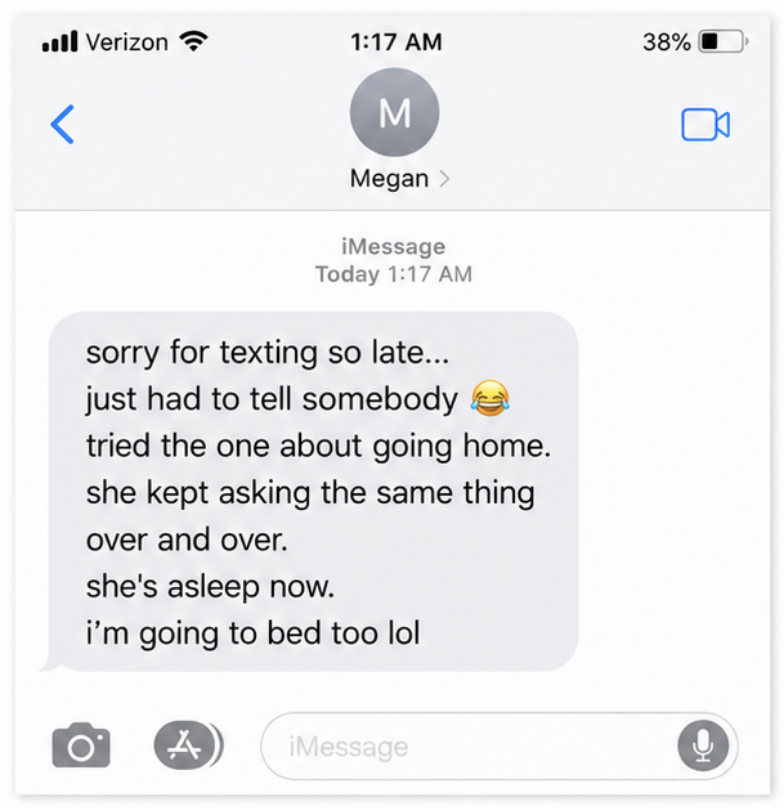
"I'm an only child, so every hard conversation is on me. It's still hard, just not as hard now. I used one of the responses when my mom kept saying she needed to go home. No idea why, but she stopped arguing. Wish I'd found this months ago."
- Tiffany
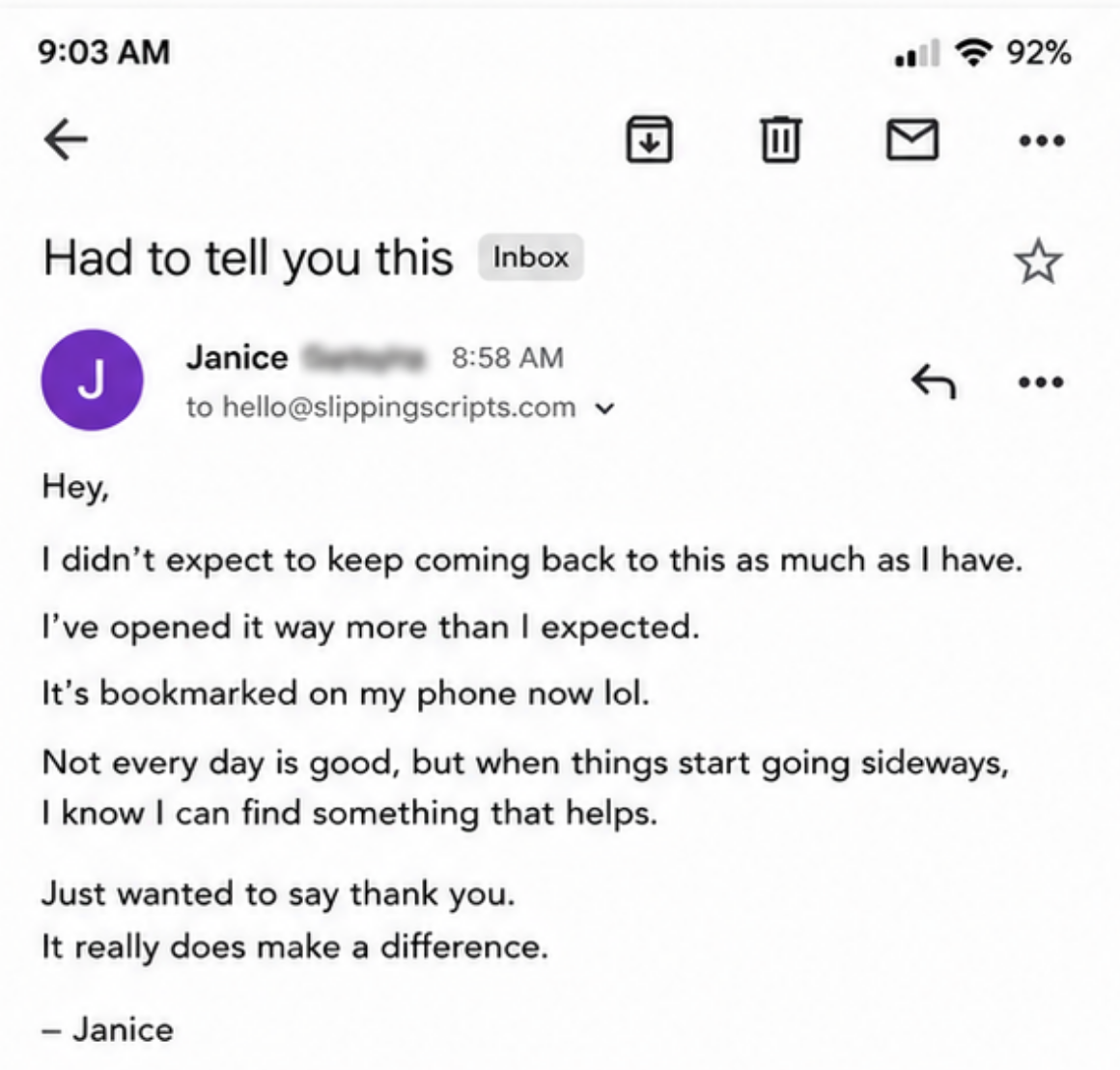
"Used one of the responses tonight when my dad got upset about me 'keeping him here.' Didn't go perfect, but I didn't snap this time. I'll take that as a win."
- Rachel K.
If you're still reading, it's probably because you recognize yourself in this. So, let me say the part no script can fix.
Because it's not really about the words you say. Picture it: it's 2 a.m. and she's standing in the living room she's lived in for thirty years, asking you to take her home, and she's looking at you like you're a stranger who's come to hurt her.
You could call someone. Except there isn't anyone to call. No brother who'll take Tuesday night. No sister who remembers the woman she used to be, so you don't have to carry the whole memory of her by yourself. It was you yesterday. It's you right now. And it'll be you at 3 a.m. tonight when she's dressed and standing by the bed asking if it's time to go.
You have family, maybe. Cousins who send a card. An aunt who calls to ask how she's doing and then tells you to take care of yourself. A brother two states away who means well and still isn't coming. But there's no one who walks in the door and says I've got her, go sleep. You learned the difference between having family and having help the hard way.
You're not failing. You are doing the single hardest thing a person can do, and you're doing it with no one beside you. That you're still standing there in that living room, holding it together at all, is not a small thing.
I needed someone to tell me that at 3 a.m. No one did. So I'm telling you.
- Carol
Here's what no one tells you, because no one's been close enough to tell you: it is not supposed to be possible to do this alone. The whole system, the doctors, the advice, the pamphlets, quietly assumes there's a team. A spouse. Siblings. Someone to split the night with. You don't have that. And wanting one thing in this to be less brutal, not for her, for you, doesn't make you ungrateful or a bad daughter. It makes you someone who's carried this longer than anyone should without help.
When she turns suddenly, more paranoid and confused than she was yesterday, that's often not the dementia getting worse. In older adults it's frequently a urinary tract infection, which can show up in the mind instead of the body, with no fever and no pain. The script for that moment tells you to call the doctor and ask them to check for a UTI before you assume she's declined. Most people miss this. They see her get worse and assume the disease is winning. But it can be a simple infection, and a doctor can treat it. If you don't know to check, you can lose weeks being scared of a decline that wasn't real.
And that UTI catch isn't a hunch. Cedars-Sinai and Northwestern Medicine both flag it: in someone with dementia, a routine urinary tract infection can trigger sudden delirium, and it's one of the most-missed things in their care. Every script with a medical edge like that was checked the same way: run past a hospice nurse and a geriatric pharmacist before it went in.
So what am I actually buying?
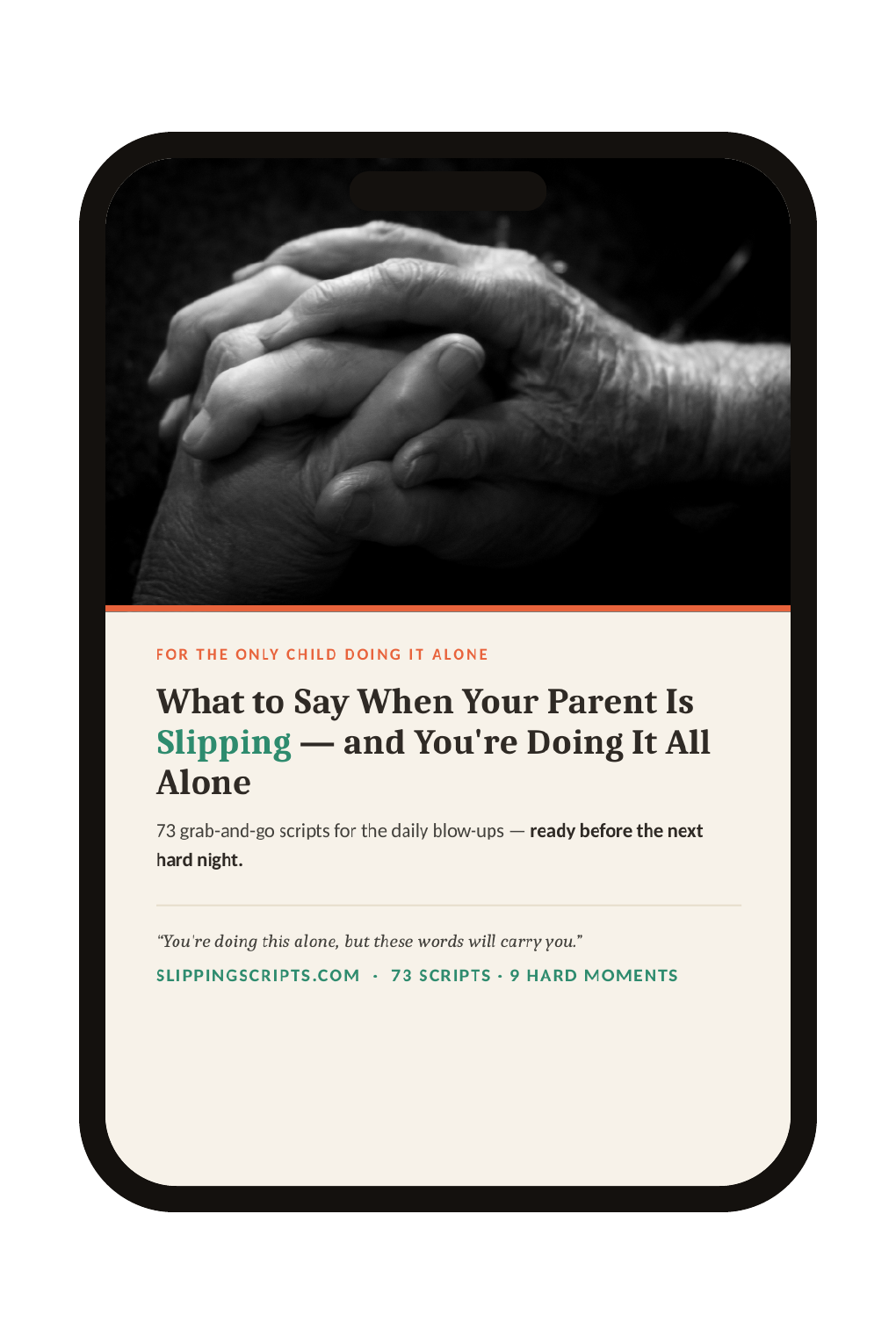
SlippingScripts is 73 scripts for the daily blow-ups of caring for a parent whose mind is slipping. Each script is one short, ready-to-read answer to one hard moment, sorted so the one you need is a tap or two away.
And here's the part everyone else leaves out, the part built for you specifically: getting through it when there's no sibling to split the night with, and no one walking in to take the next shift.
Who wrote these scripts?
These weren't written by a nurse, or a doctor, or a company that pays writers to sound like they care. They were written by an only child who had to figure this out alone, at 3 a.m., with no one to ask. Someone who wrote down what actually worked, then ran the medical parts past people who do have the letters after their name. So these aren't "here's what the research says." They're "here's what got me through the night." Tested on real nights, and straight with you about the ones where nothing works.
If you wanted a professional talking down at you, those books exist. This isn't that.
- Carol
Get the scripts for tonight $27 · on your phone two minutes from now.
Built for the moment, not the bookshelf
The 73 scripts live in one file on your phone. Find the fight you're in, tap, and the script is right there. Nothing to dig through. Nothing to study. Nothing to print. It's on your phone two minutes after you buy. And on the nights you're too far gone to even look something up, that's what the one-page Tonight Sheet is for: every blow-up's first move, right there at a glance.
You also get two free bonus sheets
The 73 scripts are for finding the right words. These two one-pagers are for the nights you don't even have time to look:
Before you buy the scripts
"Won't this sound scripted?"
Does a nurse sound fake when she stays calm in a crisis? No. She sounds safe. These words don't reach the part of your mother that's arguing. They reach the part that's still listening for whether she's okay. To her it doesn't sound like a script. It sounds like the fight stopped.
"I've tried everything. Why would this be different?"
Because you've been using logic on a brain that can't run on logic anymore. That's not a failing on your part. Nobody hands you the manual. These scripts don't try to make her understand. They make her feel safe enough to stop fighting. That's a different tool than the one you've been reaching for.
"My situation's too complicated for generic scripts."
They're not generic. They're sorted by the exact moment you're in (the shower, the stealing accusation, the 3 a.m. wandering, the sibling who won't help) with what to say when she pushes back, because she will. Built for the messy version, not the tidy one.
"How do I get it, and how fast?"
Right after you buy, the scripts are on your phone. Open the file, find the one you need, done. Print the pages you want or keep it digital. No app, no waiting, nothing to ship.
And if part of you feels guilty spending money on this, I know that feeling. The one where everything goes to her care and nothing's supposed to be for you. So hear this clearly: this isn't for you. It's for her. It's the night she gets clean without crying. The pill she takes without the fight. The 3 a.m. she's calmed instead of terrified. Spending a little so the next hard moment goes better for her isn't indulgent. It's the cheapest, kindest thing you'll buy for her all month.
About what one hour of a paid sitter costs. Except you don't get one hour. You get a script for every blow-up, every night, for as long as you need it.
Try the scripts for 30 days. If they're not for you, email me and I'll send your money back. No questions, no forms, no sending anything back. Keep the scripts either way.
Get the scripts for tonight On your phone two minutes from now.
Here's the thing: there's a hard night coming. Maybe tonight, maybe tomorrow, but it's coming, the way it always does. You can face it the way you have been, from memory and instinct, with no one to ask at 2 a.m. Or you can have the right words ready before it starts.
P.S. Nobody hands you instructions for this. You've been working it out yourself, at 2 a.m., one bad night at a time. And if you've ever stood in that house and thought the hardest part isn't her at all, it's the family who aren't there (the cousins who send a card, the aunt who tells you to rest, the brother who still isn't coming) then these scripts were written for you. Not for "caregivers" in general. For you, doing it alone, tonight. The words are written down and ready. You just have to reach for them.